
May 26, 2026
Hardwood Floors Under Carpet Connecticut: What’s Really Down There
There’s a question that crosses the mind of nearly every owner of an older Connecticut home at some point: Is there hardwood under this carpet? It sounds almost too good to be true — the idea that decades of wall-to-wall carpet might be sitting on top of floors that need to be uncovered and refinished. But in Hartford County, where a significant portion of the housing stock dates back to the early and mid-1900s, it’s not just possible. For many homeowners, it’s exactly what’s down there.
This guide walks you through how to find out without ripping up every room, what species and conditions to realistically expect based on when your CT home was built, what’s salvageable and what isn’t, and what the process actually looks like from discovery to finished floor.
Why So Many Connecticut Homes Have Hardwood Under Carpet
Hardwood floors were the standard in American home construction for most of the 19th century and well into the 20th. It wasn’t until the postwar era — roughly the 1950s through the 1970s — that wall-to-wall carpet became fashionable. Synthetic carpet was affordable, felt modern, and was heavily marketed as a luxury upgrade. Linoleum had a similar moment in the 1960s and 70s. The result: millions of homeowners across New England covered perfectly good hardwood floors without removing them, simply laying carpet or linoleum right on top.
Connecticut’s housing stock reflects that history exactly. Colonials and capes built before 1950 almost always had hardwood as the original floor — it was simply what houses were built with. Many of those floors have been under carpet ever since, protected from foot traffic and UV exposure for 50 or 60 years. That’s not always a bad thing. In many cases, the wood underneath is in better condition than floors that were left exposed and worn down over decades.
What Species to Expect — and How to Tell by Your Home’s Age
One of the most useful clues about what’s under your carpet is your home’s construction year. Different eras favored different species, and knowing what to expect helps you assess what you might be working with before you pull up a single tack strip.
Pre-1900 homes: Wide-plank pine is the most common find in Connecticut’s oldest homes. Early colonists and builders used what was abundant and local — eastern white pine was everywhere in New England, easy to mill and work with. These wide planks, often 8 to 12 inches across, are genuinely beautiful and increasingly rare. They’re also softer than oak, which means they show wear and denting more readily, but a skilled refinisher can bring them back to life in remarkable ways. American chestnut, now nearly extinct due to the blight of the early 1900s, occasionally turns up in the oldest Connecticut homes — a genuinely rare find.
1900–1940 homes: Mass production of real hardwood flooring began in the late 1800s, when steam-powered machinery made it practical to mill denser woods than pine. Oak — both red and white — became the dominant species in Connecticut homes built during this period, typically in 2¼-inch strip flooring, which is still the most common width in older homes today. Maple also appears frequently in homes from the 1920s, favored for its light color and durability in the Art Deco era. Homes from this period represent some of the best hidden-floor discoveries: dense, durable oak that has been sitting untouched for decades and can often be refinished to look genuinely stunning.
1940–1970 homes: Post-WWII construction — the era of Cape Cod revivals and ranch-style homes throughout Hartford County — continued to use oak strip flooring heavily on main living floors. By the 1960s, kitchens had largely moved to linoleum, but living rooms, dining rooms, and bedrooms in homes from this era very commonly have 1½-inch to 2¼-inch red or white oak underneath the carpet. These are the homes where the discovery question comes up most frequently, and the answer is often yes.
Post-1970 homes: The odds drop here. Homes built in the 1970s and later increasingly used cheaper subfloor materials as the standard, with finished flooring installed on top. If you have a home built after 1975, there’s still a chance of hardwood — especially if the original owner upgraded — but it’s less likely to be original construction-standard hardwood than in earlier eras.
How to Check Without Tearing Up Your Floors
You don’t need to pull up an entire room to find out what’s underneath. Several low-disruption methods give you a clear answer in minutes.
The floor vent trick: the easiest and least invasive method. Find a floor vent in a carpeted room, unscrew the cover, and look at the edges of the opening. Carpet typically isn’t tacked down around floor vents, so you can lift the edge of the carpet and padding just enough to see what’s underneath. If you see wood planks with consistent grain, you’re likely looking at original hardwood.
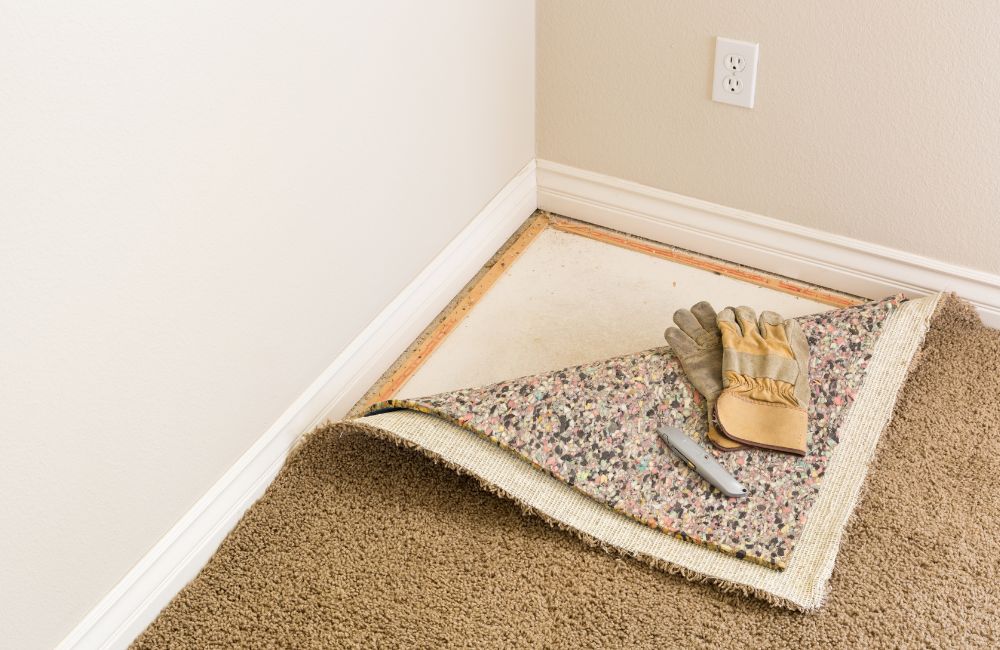
Pull a corner: In a closet or another low-visibility area, use a pair of pliers to gently pull back the carpet from the tack strip in the corner. Lift the carpet and the padding beneath it and use a flashlight to inspect what’s below. This takes about two minutes and tells you exactly what you have without disturbing any visible area of the room.
Check the basement ceiling: If your home has an unfinished basement, look up. You can often see the underside of the floor structure, which reveals whether there are finished hardwood boards above the subfloor or just plywood.
Look for exposed transitions: In doorways where carpet meets a hard floor — a tiled kitchen or an uncarpeted hallway — look at the threshold. If there’s a wooden transition piece, or you can see wood grain at the edge where the carpet ends, that’s a strong indicator that hardwood extends under the carpet in the adjacent room.
What Conditions to Realistically Expect
Finding hardwood under your carpet is exciting, but it’s worth going in with realistic expectations about what you might find. The most common issues in Connecticut homes are:
Staining from carpet padding: Rubber-backed carpet padding, particularly older foam padding from the 1970s and 80s, can break down over time, leaving dark staining on the wood beneath. Mild staining often sands out during refinishing. Severe or deep staining may require board replacement in affected areas.
Pet stains: Dark black or deep brown staining from pet urine is one of the most common problems found under carpet in older homes. Depending on depth, these stains can sometimes be sanded out, but deep penetration into the wood may require replacing affected boards.
Previous damage that prompted the carpeting: Sometimes carpet was installed specifically to hide a problem — warped boards, water damage, or a bad previous refinish job. It’s worth checking multiple areas of a room rather than assuming the whole floor is in the same condition as the corner you checked.
Nail holes from the tack strip: The tack strips that hold carpet in place leave a row of small nail holes along the perimeter of each room. These are almost always sanded away and invisible after refinishing — they rarely affect the outcome.
The good news: Floors that have been under carpet are often in better shape than floors that have been lived on for decades. Protected from UV fading, foot traffic, and repeated cleaning cycles, covered hardwood flooring often retains more finish and structural integrity than you’d expect.
What Restoration Actually Involves
If the floors check out — right species, reasonable condition — the restoration process is straightforward. Carpet and padding are removed, tack strips are pulled, and any remaining staples or adhesive residue are cleaned up before sanding begins. A professional sanding removes the old finish and surface damage, leaving bare wood. Stain is applied if desired, followed by multiple coats of finish. In most cases, a main-floor restoration in a Hartford County home takes 2 to 3 days from carpet removal to the final coat.
The cost is almost always less than installing new hardwood — typically $3–$8 per square foot for professional refinishing versus $8–$20 or more for new installation. If the floors are there and in decent shape, restoration is almost always the better financial decision.
The Bottom Line
If you own an older Connecticut home with wall-to-wall carpet and you’ve never checked what’s underneath, it takes about five minutes to find out. The floor vent trick requires no tools, no damage, and no commitment — just a screwdriver and a flashlight. If you find hardwood, you’ll know immediately whether you’re sitting on a restoration project worth pursuing. Many Hartford County homeowners have been genuinely surprised by what was there all along.
Frequently Asked Questions
How do I know if the hardwood under my carpet is worth restoring?
The main factors are species, thickness, and condition. Oak and maple are the most refinishable species — dense, durable, and sandable multiple times. Pine is refinishable but softer and more prone to denting. In terms of condition, minor staining, surface scratches, and general wear typically sand out cleanly. Deep pet staining, severe water damage, or significant structural warping may require board replacement, which adds cost but doesn’t necessarily make restoration impractical. A professional assessment before committing is always worthwhile.
Can hardwood floors under carpet be refinished if they’ve never been finished before?
Yes. Bare, unfinished wood actually sands very cleanly and takes stain and finish beautifully — sometimes better than floors that have been finished and refinished multiple times. Wide-plank pine floors in pre-1900 Connecticut homes, for example, are often bare or lightly surface-treated and respond exceptionally well to a careful restoration process.
What if I find linoleum under the carpet instead of hardwood?
It’s common, especially in homes from the 1960s and 70s, to find linoleum rather than hardwood under carpet — or linoleum on top of hardwood. Check underneath the linoleum if possible, particularly in homes built before 1940. Hardwood under linoleum under carpet is a real scenario, and the floors are often in excellent condition, having been double-protected for decades.
How long does hardwood floor restoration take in a typical Hartford County home?
For a main-floor restoration — carpet removal, tack strip removal, sanding, staining (if desired), and finish coats — most projects take 2 to 3 days. Larger homes or projects requiring significant board replacement take longer. The home is typically livable throughout the process, though you’ll need to stay off the freshly finished floors for 24 hours between coats.
Is it possible to have hardwood in some rooms but not others?
Absolutely. It was common practice to install hardwood in formal living spaces — living rooms, dining rooms, and sometimes bedrooms — while using cheaper subfloor materials in kitchens, bathrooms, and secondary spaces. Don’t assume that finding hardwood under one floor vent means it continues throughout the house. Check each room independently, particularly if your home has had any additions or renovations since original construction.
Sources
Floors To Your Home — “A History of Hardwood Flooring”
Old House Online — “The History of Wood Flooring”
The Craftsman Blog — “Identifying Different Types of Wood Flooring”
Classic Wood Floors — “How to Know if You Have Hardwood Under Carpet”
—
If you’ve found hardwood under your carpet and want to know whether it’s worth restoring, Mr. Hardwood offers free assessments and estimates throughout Hartford County. Call 203-GOT-WOOD or visit mrhardwood.com.