
July 20, 2026
Hardwood Stair Refinishing Connecticut: Complete Guide
The staircase is one of the first things visitors see when they walk into a Connecticut home — and one of the last things homeowners think about when it comes to maintenance. While hardwood floors in the living room and dining room get attention and care, the stairs that connect every level of the house take a concentrated beating every single day. Each tread absorbs more foot traffic per square inch than almost any other surface in the home, and that wear accumulates fast. By the time a staircase looks noticeably worn, it’s usually been overdue for attention for a while.
Hardwood stair refinishing in Connecticut is a different process than refinishing a flat floor — it’s more labor-intensive, more time-consuming, and requires a different skill set. Understanding what it actually involves, what it costs, and when refinishing makes sense versus replacement helps Connecticut homeowners make the right call before spending money in the wrong direction.
Why Stairs Are Harder to Refinish Than Flat Floors
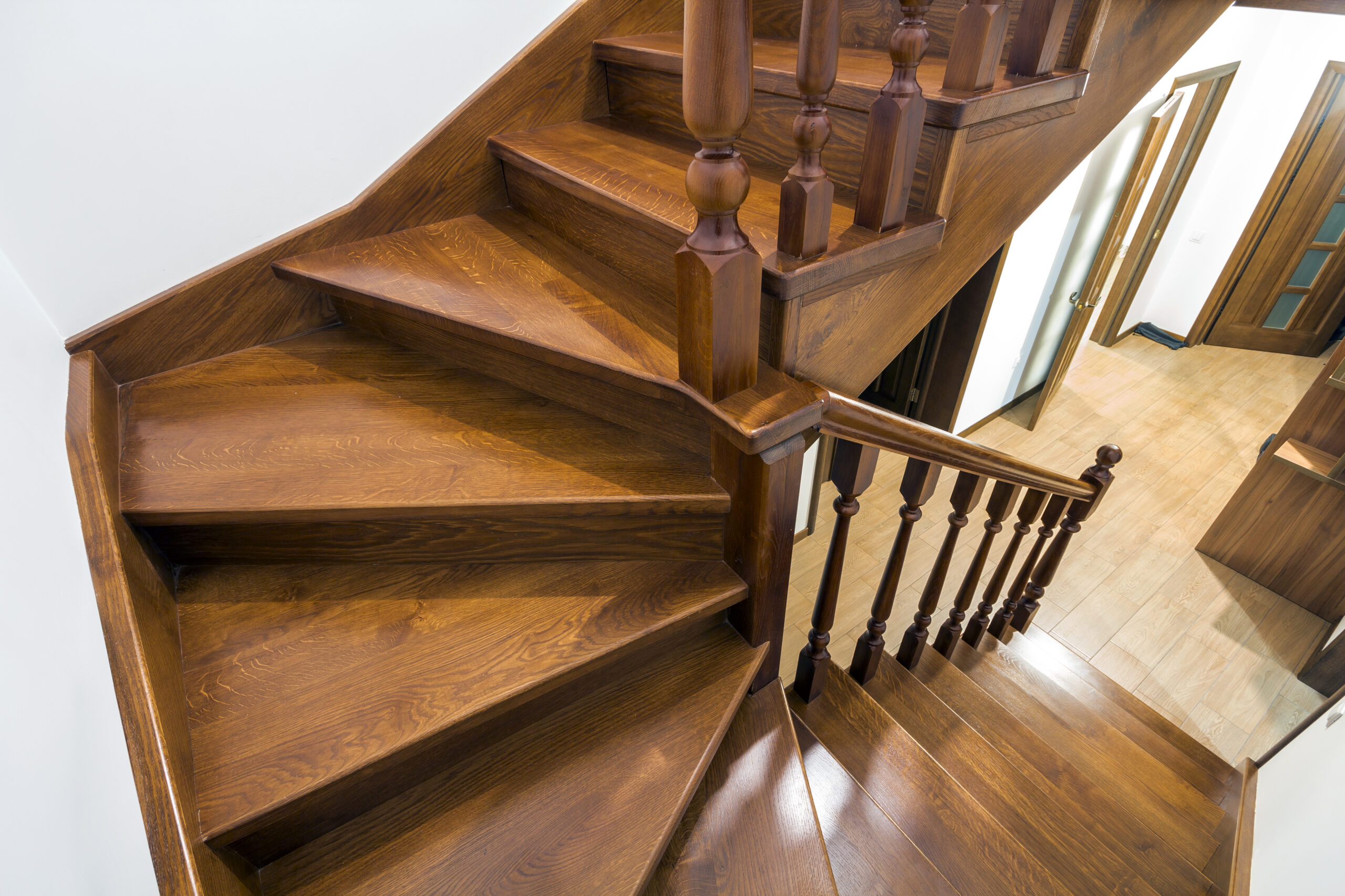
When most homeowners think about floor refinishing, they picture a large sanding machine running across an open living room floor. Stairs don’t work that way. The geometry of a staircase — treads, risers, nosings, balusters, stringers, and a handrail — makes every surface a tight, angled space that a drum sander can’t reach. Each tread has to be sanded by hand or with a small detail sander. Each riser, each edge, each nosing requires individual attention. That’s why stair refinishing is priced per step rather than per square foot, and why labor accounts for a significantly higher proportion of the cost than on flat floors.
For a standard straight staircase in a Hartford County home — typically 12 to 16 steps — professional stair refinishing runs approximately $40 to $75 per step, putting a typical project in the $700 to $1,200 range for treads alone. More complex staircases — curved, with a landing, or with open sides that expose the stringers — take significantly longer and cost more. Staircases with ornate balusters, carved newel posts, or detailed railings that need to be addressed alongside the treads can push the project into the $2,000 to $3,800 range or higher depending on scope.
What Stair Refinishing Actually Involves
A professional stair refinishing project in Connecticut typically follows the same fundamental steps as flat floor refinishing — but applied to a much more labor-intensive surface.
Assessment and prep: Before any sanding begins, the condition of each tread and riser is evaluated. Loose treads are secured, protruding nails or staples from old carpet are removed, and any structural issues — squeaky steps, unstable balusters, cracked nosings — are addressed. Skipping prep work and going straight to sanding is one of the most common mistakes in DIY stair refinishing, and it shows in the final result.
Sanding: Each tread is sanded by hand or with a detail orbital sander, progressing through grits to achieve a smooth, clean surface. The nosing — the rounded front edge of each tread that takes the most foot traffic — requires particular care. Risers, if they’re being refinished rather than painted, are sanded separately. On a 14-step staircase, this process takes far longer than sanding an equivalent square footage of flat floor.
Staining (optional): If a stain is being applied, it goes on after sanding and before finish coats. For Connecticut homeowners who are refinishing their stairs as part of a larger project — updating the main floor hardwood at the same time, for example — matching the stair stain to the new floor stain is an important coordination step. For guidance on stain color selection that holds up over time, see Mr. Hardwood’s guide to hardwood stain colors in Connecticut homes.
Finish coats: Two to three coats of polyurethane — water-based or oil-based depending on the desired look and timeline — are applied with drying time between each coat. Water-based finishes dry faster and have lower odor, which matters in a Connecticut home where stair access needs to be restored. Oil-based finishes take longer to cure but produce a warmer tone that many homeowners prefer in older colonial and cape homes.
Drying and curing: This is where stair refinishing creates the most household disruption. Unlike a flat floor where one room can be closed off, stairs connect every level of the home. During the finishing process — and for several hours after each coat — the stairs cannot be walked on. Most contractors manage this by working in sections, allowing one side of the staircase to dry while the other is accessible, or by scheduling finish coats at the end of the day so curing happens overnight.
Treads Only vs. Full Staircase Refinishing
A common question in Connecticut stair refinishing projects is whether to address treads only or do a full refinishing that includes risers, balusters, and handrail. The right answer depends on the current condition and the desired outcome.
Treads only makes sense when the risers are painted rather than stained—a common configuration in older Hartford County homes, where painted white risers with stained treads are the traditional aesthetic. In these cases, the risers get a fresh coat of paint while the treads are sanded and refinished. This is the most common and cost-effective scope for stair refinishing in Connecticut.
Full staircase refinishing makes sense when the entire staircase is stained wood, when the handrail and balusters show significant wear or discoloration, or when the homeowner wants a uniform result throughout. Full refinishing takes longer and costs more, but the outcome — a completely refreshed staircase from top to bottom — is more dramatic and adds more visual value.
When Refinishing Makes Sense vs. When to Replace
Stair refinishing is the right call when the staircase is structurally sound, and the damage is surface-level — worn finish, light scratching, dullness, or an outdated stain color that no longer matches the rest of the home. In these situations, refinishing restores the staircase to like-new condition at a fraction of the cost of replacement.
Replacement becomes the better option in a few specific scenarios. Treads that are structurally cracked, deeply gouged, or damaged by water to the point of rot cannot be sanded back to a usable surface — they need to be replaced. Staircases with significant structural movement — wobbling newel posts, loose stringers, steps that feel unsafe underfoot — need structural repair before any refinishing work is appropriate. And homeowners who want a complete design change — new species, new layout, or a completely different baluster and railing style — are better served by replacement than by trying to dramatically transform an existing staircase through refinishing alone.
In most Connecticut homes, particularly colonials and capes with original oak staircases that have been worn down over decades, refinishing is the right call. A staircase that looks genuinely wrecked at the surface is often in better structural shape than it appears — and a professional refinishing transforms it completely.
Coordinating Stair Refinishing With Other Floor Projects
The most practical time to refinish stairs in a Connecticut home is when other hardwood floor work is already being done — refinishing the main floor, installing new hardwood in a bedroom, or doing a renovation that requires the flooring contractor to be on site anyway. Coordinating stair refinishing with a larger project saves mobilization costs, ensures that stain colors match across surfaces, and reduces the overall household disruption compared to scheduling it as a standalone project.
For Connecticut homeowners who are refinishing their main floors and have been living with worn-out stairs, adding the staircase to the scope is almost always the right financial decision. The incremental cost is lower than scheduling a separate stair project, and the visual result — floors and stairs that match and look intentionally refreshed together — is significantly better than a newly refinished floor that leads up to a worn-out staircase. For more on the full refinishing process, see Mr. Hardwood’s guide to hardwood floor refinishing in Connecticut.
The Bottom Line
Stair refinishing is one of the most visually impactful projects a Connecticut homeowner can do — and one of the most underestimated in terms of what it actually involves. It’s not the same as refinishing a flat floor; it takes longer than most people expect, and it requires experience with the specific challenges of working in tight, angled spaces. Done well, a refinished staircase transforms the entire entryway of a Hartford County home and brings the whole interior together. Done poorly, it’s immediately visible every time someone walks through the front door.
Frequently Asked Questions
How long does stair refinishing take in a Connecticut home?
A standard straight staircase with 12 to 16 steps typically takes two to four days from start to finish, including sanding, staining if applicable, and two to three finish coats with drying time between each. More complex staircases — curved, with a landing, or with full baluster and railing work — can take five to seven days. The most significant time factor in Connecticut is managing finish cure times in the state’s variable humidity — water-based finishes cure faster in summer’s warm, dry AC conditions than in the damp shoulder seasons of spring and fall.
Can I use my stairs while they’re being refinished?
Yes, but with limitations. Most professional contractors manage stair access during refinishing by working in sections — finishing one side while the other dries — or by scheduling finish coats at the end of the workday so the staircase can cure overnight without disrupting access. The full staircase is typically inaccessible for a few hours after each finish coat. Planning around this — particularly in multi-story Connecticut homes where upper-floor bedrooms depend on stair access — is something to discuss with your contractor before the project begins.
How do I match refinished stairs to my existing hardwood floors?
Matching is one of the trickier elements of stair refinishing, particularly in older Connecticut homes where the existing floor has aged and developed a patina that new stain doesn’t automatically replicate. The most reliable approach is to refinish the stairs at the same time as the main floor — both surfaces are sanded to bare wood and stained simultaneously, producing a uniform result. When stairs are being refinished independently, an experienced contractor will test stain samples on the actual tread wood before committing to a color, since different species absorb stain differently.
Is it worth refinishing painted stairs?
If the painted risers are in good condition, stripping paint and refinishing to bare wood is a bigger project than most homeowners anticipate—paint removal requires additional chemical stripping or sanding time, which significantly increases cost and project duration. For most Connecticut homes with painted risers, the practical approach is to leave the risers painted, refresh the paint with a new coat, and focus the refinishing work on the treads. The result — stained treads with fresh white risers — is a classic New England stair aesthetic that looks intentional and works well in colonial and cape-style homes.
How much does stair refinishing cost in Connecticut?
In Hartford County, professional stair refinishing typically runs $40 to $75 per step for tread refinishing, putting a 14-step staircase in the $560 to $1,050 range for treads alone. Full-scope projects that include risers, balusters, and handrail work, or staircases with complex geometry, can run $2,000 to $3,800 or more. Adding stair refinishing to an existing floor refinishing project — rather than scheduling it as a standalone visit — generally reduces the per-step cost since the larger project already covers mobilization and setup.
Sources
Angi — “How Much Does It Cost to Refinish Stairs?” (2026)
Soto Flooring — “Hardwood Refinishing Cost Guide: Labor & Finishes” (2025)
Floorecki — “Stair Refinishing vs Replacement: How to Decide What Your Home Really Needs” (2026)
Renova Flooring — “Refinishing vs. Replacing Your Stairs: Which Option Adds More Value?” (2025)
Stair Creations — “Refinishing Stairs Cost vs. Replacement: What’s Smart?” (2026)
HomeAdvisor — “How Much Does It Cost to Refinish Stairs?” (2025)
—
Ready to refinish your stairs in Hartford County? Mr. Hardwood offers free estimates on stair refinishing throughout Connecticut. Call 203-GOT-WOOD or visit mrhardwood.com to get started.