
August 18, 2026
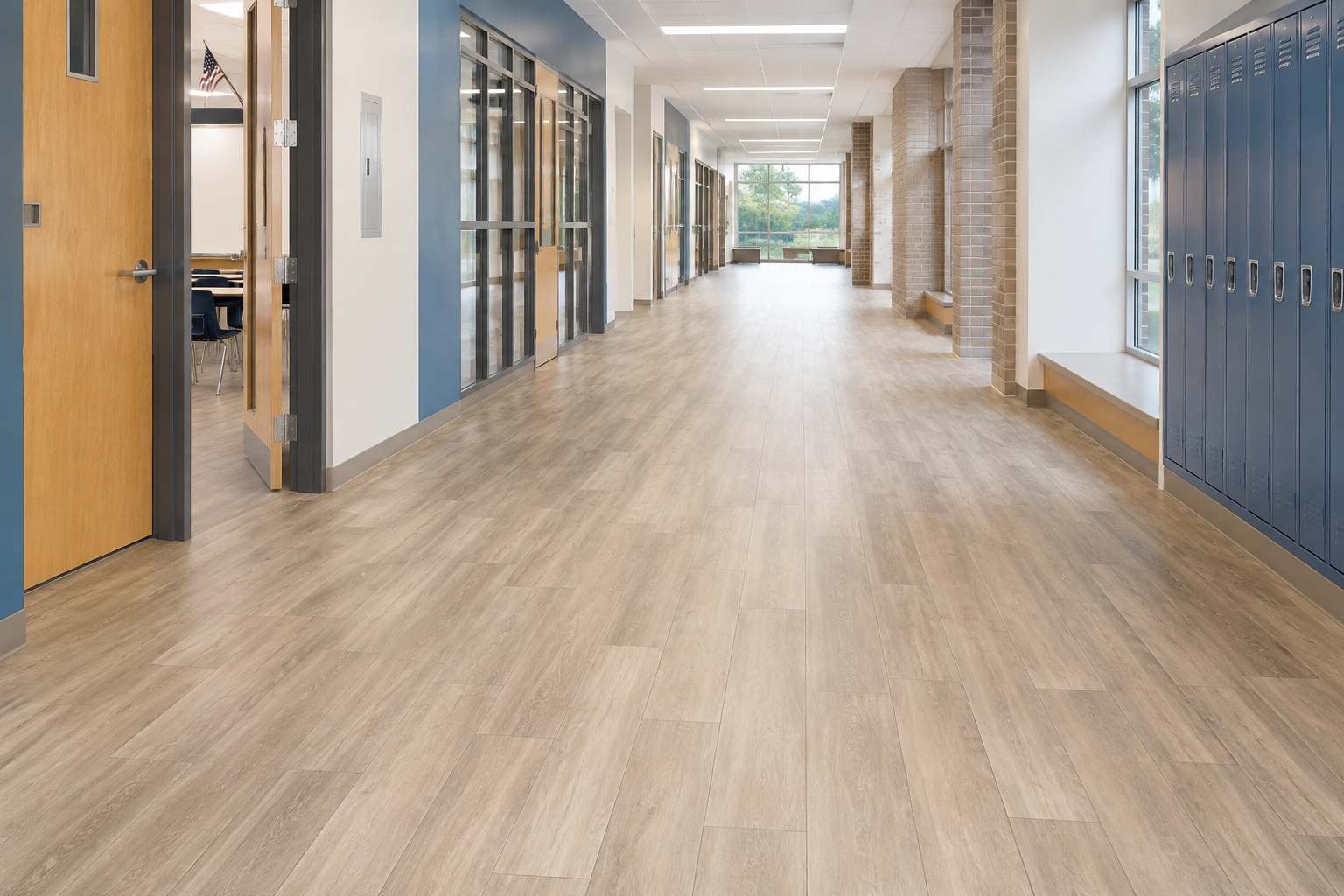
As Hartford & Tolland County Schools Chase State Construction Dollars, Commercial LVT Is Replacing the Old Wax-and-Strip Floor
Wethersfield voters recently faced a $239 million question: whether to rebuild two aging elementary schools and replace a third, with the state covering more than 70% of the cost through Connecticut’s school construction grant program. Consultants told the town it would need to spend roughly $60 million just to keep the current buildings functional — and that money would only patch roofs and mechanical systems, not modernize a single classroom.¹ A few towns over, East Windsor is weighing a $145 million overhaul of three schools built in the 1950s and ’60s, after a required feasibility study on HVAC upgrades turned up building envelope problems the district didn’t know it had.²
These aren’t isolated stories. Connecticut just restructured how it funds school facilities: starting in FY 2026, a new Districts Repair and Improvement Program (DRIP) put $60 million in general obligation bonds on the table specifically for the kind of minor capital repairs — including interior finishes — that districts previously had no dedicated funding source for at all.³ Add in dozens of major Priority List renovations working through the state’s 10% to 80% reimbursement scale, and Hartford and Tolland County school facilities departments are looking at the busiest flooring replacement cycle in years.⁴ For every one of those projects, the same decision comes up early: does the new floor go back down as VCT, or does the district finally move to LVT?
The Real Cost Isn’t the Install — It’s the Decade After
VCT (vinyl composition tile) still shows up in a lot of bid specs because the material itself is cheap, often $1 to $3 per square foot versus $3 to $7 for LVT.⁵ What doesn’t show up in that comparison is the maintenance program VCT requires to keep looking presentable: stripping, waxing, and burnishing on a cycle that can run as often as twice a month in high-traffic corridors.⁶ Every one of those cycles uses custodial labor hours, machine time, and chemical strippers — some of which contain VOCs like 2-butoxyethanol, an odd thing to be reapplying in a building full of children with developing lungs.⁷
Facilities teams that have run the lifecycle math for a 50,000-square-foot building have found that LVT can save well over $250,000 over a decade once the stripping-and-waxing program is factored in — a bigger swing than most people expect from a flooring decision.⁸ That math matters even more in a state construction grant world, where districts front the cost and get reimbursed later; every dollar saved on operating budget is a dollar the town doesn’t have to justify at budget season.
What We Spec for CT School Corridors and Classrooms
- Wear layer of 20 mil or heavier in corridors and cafeterias, where rolling carts, lunch trays, and thousands of daily footsteps are the norm; lighter-traffic classrooms can run a lower mil rating.
- FloorScore-certified, low-VOC product — non-negotiable in an occupied school, and increasingly expected in state grant applications that weigh indoor air quality.
- NFSI and ANSI B101.1 slip-resistance data for entryways, where New England winters mean salt, slush, and wet boots track in for months at a stretch.
- Click-lock or glue-down installation sequenced around the academic calendar — most of our district work happens in the compressed summer window between the last bus and the first day back.
Built for Connecticut’s Older School Buildings
A large share of Hartford and Tolland County’s school stock predates modern moisture barriers — slab-on-grade construction from the 1950s through ’70s, the same era East Windsor and Wethersfield are now grappling with. That’s exactly the environment where VCT’s porous limestone composition becomes a liability: moisture migrates through the tile and the adhesive over time, especially with CT’s humid summers and freeze-thaw winters. Rigid-core LVT (SPC/WPC) is built to resist that moisture movement without the constant re-sealing VCT depends on, which is why it’s become the first call for districts modernizing older buildings rather than replacing them outright.
“Facilities directors don’t have the summer staffing to run a wax program the way they used to, and they know it. When we walk a district through the ten-year cost — not just the bid price — LVT usually sells itself. We can turn a corridor around in a single summer window and hand it back ready for the strip-and-wax crew to retire.”
— Rob Girard, Owner, Mr. Hardwood
Get a Commercial Flooring Estimate
Mr. Hardwood is based in Rocky Hill and works with school facilities teams and general contractors throughout Hartford County and Tolland County — from Priority List renovations in Glastonbury and Wethersfield to DRIP-funded repairs in Vernon, Coventry, and Middletown. If your district is scoping flooring for an upcoming project, we can walk your facilities team through wear-layer, slip-resistance, and FloorScore specs before the bid goes out.
Call 203-GOT-WOOD or visit this page to schedule a school flooring consultation.
Sources
- Yahoo News, “Voters in CT town to decide on $239 million schools renovation plan,” 2026. https://www.yahoo.com/news/articles/voters-ct-town-decide-239-094500355.html
- Patch, “East Windsor Schools Eye $145M Overhaul,” 2026. https://patch.com/connecticut/windsorlocks/east-windsor-could-vote-major-school-renovations-new-construction-november
- School State Finance, “2025 Legislative Session: Impacts to School Construction and Capital Projects.” https://schoolstatefinance.org/hubfs/Reports/2025%20Legislative%20Session:%20Impacts%20to%20School%20Construction%20and%20Capital%20Projects.pdf
- State of Connecticut DAS, “School Construction State Reimbursement Percentages.” https://portal.ct.gov/das/grants/school-construction-grant-resources/school-construction-state-reimbursement-percentages
- Consolidated Flooring, “LVT vs. VCT: Key Differences and How to Choose,” 2026. https://consolidatedflooring.com/lvt-vs-vct/
- CST Triad, “Caring for Commercial Vinyl Floors: How VCT and LVT Compare.” https://cstriad.com/commercial-vinyl-floor-care/
- G. Capobianco, “LVT in Education,” research paper citing Hospital Employee Health (2006). https://avaflor.com/wp-content/uploads/2022/06/GCapobianco_LVTInEducation-220408.pdf
- RJ Inc., “School Flooring Costs: VCT vs LVT Lifecycle Guide,” 2026. https://rj-inc.com/blog/commercial-school-flooring-costs-lifecycle-cost-analysis-of-vct-vs-lvt