
September 10, 2026
Bamboo Flooring Connecticut: Is It Actually Worth It?
Bamboo flooring has a devoted following—and for good reason. It’s made from a rapidly renewable resource that reaches harvest maturity in five to six years, compared to decades for most hardwood species. It’s visually striking. And depending on the type, it can be remarkably hard — harder than most domestic hardwoods. For Connecticut homeowners who care about sustainability and want something that stands apart from the standard oak floor, bamboo flooring is an appealing option worth serious consideration.
But bamboo flooring in Connecticut comes with real caveats that most product guides gloss over, and knowing them before you install is the difference between a floor that performs beautifully for years and one that gives you problems within the first winter. This guide covers what bamboo flooring actually is, how different types compare on durability, how it performs in Connecticut’s specific climate, and who it genuinely makes sense for — and who should look elsewhere.
What Bamboo Flooring Actually Is
The first thing to understand about bamboo flooring is that it isn’t wood. Bamboo is a grass — one of the fastest-growing plants on earth —, and its flooring applications are the result of processing bamboo stalks into floor planks through a manufacturing process rather than milling them from a tree. That distinction matters because bamboo’s properties differ from wood in important ways that affect how it performs in Connecticut’s climate.
Three primary types of bamboo flooring exist, and they are not interchangeable in terms of hardness, stability, or appearance.
Horizontal and vertical bamboo are the traditional forms. In horizontal bamboo, strips of bamboo are laid flat and laminated together; in vertical bamboo, the strips are turned on their edge. Both methods produce flooring that shows the distinctive nodes of the bamboo stalk. These products typically score around 1,000 to 1,400 on the Janka hardness scale — comparable to red oak — and are the entry-level form of bamboo flooring. They’re the most affordable and the most moisture-sensitive of the three types.
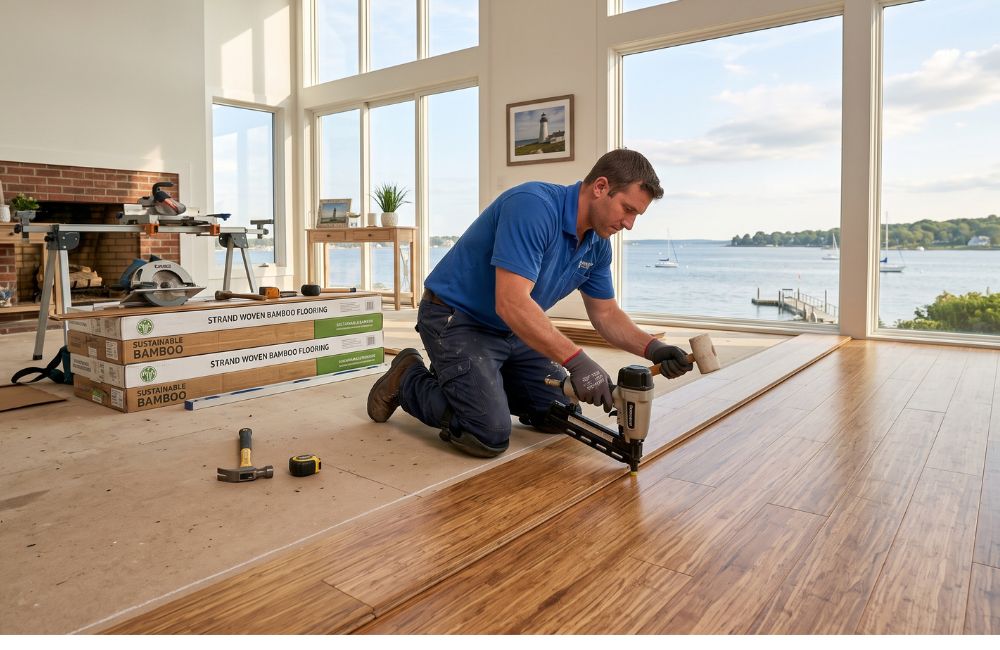
Strand-woven bamboo is a fundamentally different product. In this process, bamboo fibers are shredded, saturated with adhesive, and compressed under extreme heat and pressure into incredibly dense planks. The result is a material that scores between 3,000 and 5,000 on the Janka scale — two to four times harder than most domestic hardwoods, including hickory and white oak, and harder than most exotic species. Strand-woven bamboo is significantly more dimensionally stable than horizontal or vertical bamboo, and its compressed fiber structure gives it a marbled, tiger-stripe grain pattern that looks quite different from traditional bamboo’s nodular appearance.
For Connecticut homeowners considering bamboo, strand-woven is almost always the right specification. The hardness advantage over traditional bamboo is substantial, and the improved stability matters in a climate with Connecticut’s seasonal humidity swings.
How Bamboo Performs in Connecticut’s Climate
This is where the honest conversation begins. Bamboo, like hardwood, is hygroscopic — it absorbs and releases moisture from the surrounding air. That means it expands in Connecticut’s humid summers and contracts in the dry heating season, just like hardwood. The same challenges apply to bamboo in Hartford County’s climate as they do to oak or maple: without active humidity management, bamboo floors gap in winter, expand in summer, and accumulate stress over repeated seasonal cycles.
Strand-woven bamboo handles those swings better than horizontal or vertical bamboo due to its denser construction, but it is not immune. The National Wood Flooring Association recommends maintaining indoor humidity between 30–50% for wood and wood-adjacent flooring materials — that guidance applies to bamboo as well. Connecticut homeowners with bamboo floors need the same active humidity management as those with hardwood: a humidifier during heating season, consistent AC or dehumidification in summer.
Bamboo has one climate-specific advantage over some hardwood species: strand-woven bamboo’s extreme density means it resists surface scratching and denting better than softer wood species under the abrasion of tracked-in grit and daily foot traffic. For Connecticut homes with active households where floor wear is a concern, that hardness advantage is meaningful.
Where bamboo clearly should not go in a Connecticut home: basements, mudrooms, bathrooms, laundry rooms, or any space with regular moisture exposure. Like hardwood, bamboo should never be installed below grade. Connecticut basements retain moisture year-round, and seasonal dampness creates conditions that will damage bamboo over time, regardless of product quality. For those spaces, LVP is the appropriate choice.
Bamboo vs. Hardwood: Where Each Wins
For Connecticut homeowners deciding between bamboo and hardwood, the comparison comes down to a few key tradeoffs.
Hardness: Strand-woven bamboo wins decisively over most hardwood species. It’s harder than hickory, harder than white oak, and harder than most exotic species. If scratch and dent resistance is the priority, strand-woven bamboo is one of the toughest natural flooring options available.
Refinishability: Hardwood wins here, and it’s a significant advantage for long-term value. Solid hardwood can typically be sanded and refinished five to ten times over its lifetime, effectively renewing the surface every decade or so. Bamboo can generally be refinished only once or twice — strand-woven bamboo’s compressed structure can behave unpredictably when sanded, and the wear layer is thinner than most solid hardwood. A well-maintained solid oak floor in a Connecticut colonial can last 100 years or more. Bamboo typically lasts 20 to 25 years before it needs replacement. For more on refinishing and floor longevity, see Mr. Hardwood’s guide to hardwood floor refinishing lifespan.
Sustainability: Bamboo wins clearly. Bamboo reaches harvest maturity in five to six years versus decades for hardwood species. For environmentally conscious Connecticut homeowners, bamboo’s rapid renewability is a real advantage—particularly when sourced from certified sustainable manufacturers.
Resale value: Hardwood holds the edge in Connecticut’s real estate market. Buyers and appraisers in Hartford County still value real hardwood as a premium feature in ways that bamboo — however high-quality — doesn’t fully replicate. For homeowners planning to sell within the next several years, hardwood in the main living spaces delivers stronger returns.
Cost: Premium strand-woven bamboo overlaps with mid-range hardwood in price, typically running $5 to $9 per square foot installed. Traditional hardwood in species like red oak runs $8 to $20 or more installed. At equivalent price points, strand-woven bamboo often delivers more hardness for the dollar than comparable hardwood options.
Whom Bamboo Flooring Makes the Most Sense For in Connecticut
Bamboo is the right choice for Connecticut homeowners who prioritize sustainability and want a natural floor material that’s significantly harder than standard hardwood — particularly in households with pets, high foot traffic, or active kids where dent and scratch resistance matters. Strand-woven bamboo in a main-floor living space with active humidity management is a durable, visually distinctive choice that will perform well for two decades or more.
Bamboo is the wrong choice for Connecticut homeowners who want a floor they can refinish multiple times over a 50-year period, who are choosing primarily for resale value, or who are considering it for any moisture-exposed space. In those situations, solid hardwood or LVP — depending on the room — is the more appropriate material.
The Bottom Line
Bamboo flooring in Connecticut is worth it for the right homeowner in the right application. Strand-woven bamboo in particular offers a combination of hardness, sustainability, and distinctive appearance that hardwood can’t match at its price point — provided it’s installed in a climate-controlled above-grade space with active humidity management. For those who understand its limitations and choose it intentionally, it performs and looks impressive. If you expect it to behave like hardwood in all the ways that matter for a long-term investment, it will disappoint.
Frequently Asked Questions
Is bamboo flooring a good choice for Connecticut homes?
In the right application, yes. Strand-woven bamboo installed in a climate-controlled, above-grade living space with consistent humidity management performs well in Connecticut. Its extreme hardness makes it more resistant to daily wear than most hardwood species. Its limitations — moisture sensitivity, limited refinishability, lower resale value than hardwood — make it less appropriate for moisture-prone rooms or homeowners prioritizing long-term investment value.
What is the difference between strand-woven and traditional bamboo flooring?
Traditional horizontal and vertical bamboo flooring is made by laminating strips of bamboo together, producing a product that’s roughly as hard as red oak at around 1,000 to 1,400 on the Janka scale. Strand-woven bamboo is made by shredding bamboo into fibers, then compressing them under extreme heat and pressure into dense planks that score 3,000 to 5,000 on the Janka scale — two to four times harder than most domestic hardwoods. Strand-woven bamboo is also more dimensionally stable than traditional bamboo, making it a much better choice for Connecticut’s climate.
Can bamboo floors be refinished?
Bamboo can be refinished, but with more limitations than solid hardwood. Most bamboo flooring can be refinished once or twice over its lifetime, compared to five to ten times for solid hardwood. Strand-woven bamboo’s compressed fiber structure requires careful sanding, and its wear layer is thinner than most solid hardwood products. If refinishing and renewing the floor multiple times over decades matters, solid hardwood offers a significant advantage over bamboo.
Does bamboo flooring hold up to pets in Connecticut?
Strand-woven bamboo is one of the hardest natural flooring options available and handles pet nail traffic better than most hardwood species. Its Janka rating of 3,000 to 5,000 puts it well above hickory (1,820) and white oak (1,360), so it resists surface scratching from dog claws better than most alternatives. The caveat for Connecticut pet households is moisture — pet accidents need immediate cleanup on bamboo just as on hardwood, and bamboo should not be installed in rooms where moisture exposure is frequent.
How long does bamboo flooring last in a Connecticut home?
Quality strand-woven bamboo installed correctly in a climate-controlled space typically lasts 20 to 25 years. Traditional horizontal or vertical bamboo may last 15 to 20 years with proper care. Both lifespans are shorter than solid hardwood, which can last 50 to 100 years or more with periodic refinishing. The tradeoff is that bamboo’s initial hardness means it often reaches that 20-year mark with less surface wear than an equivalent hardwood floor might show, particularly in high-traffic areas.
Sources
This Old House — “Bamboo Flooring: A Buyer’s Guide” (2026)
D and G Flooring — “Bamboo vs Hardwood Flooring: A Complete Side-by-Side Comparison” (2026)
Flooring Explorer — “Strand Woven Bamboo Flooring: The Hardest Option” (2026)
Ambient BP — “Does Bamboo Flooring Need To Acclimate Before Installation?” (2026)
Magic Bambu — “How Bamboo Flooring Performs in High Humidity Environments”
Rejuvenation Floor & Design — “Best Flooring for a Humid Climate” (2026)
—
Considering bamboo flooring for your Connecticut home? Mr. Hardwood installs bamboo throughout Hartford County and offers free estimates. Call 203-GOT-WOOD or visit mrhardwood.com.