
June 30, 2026
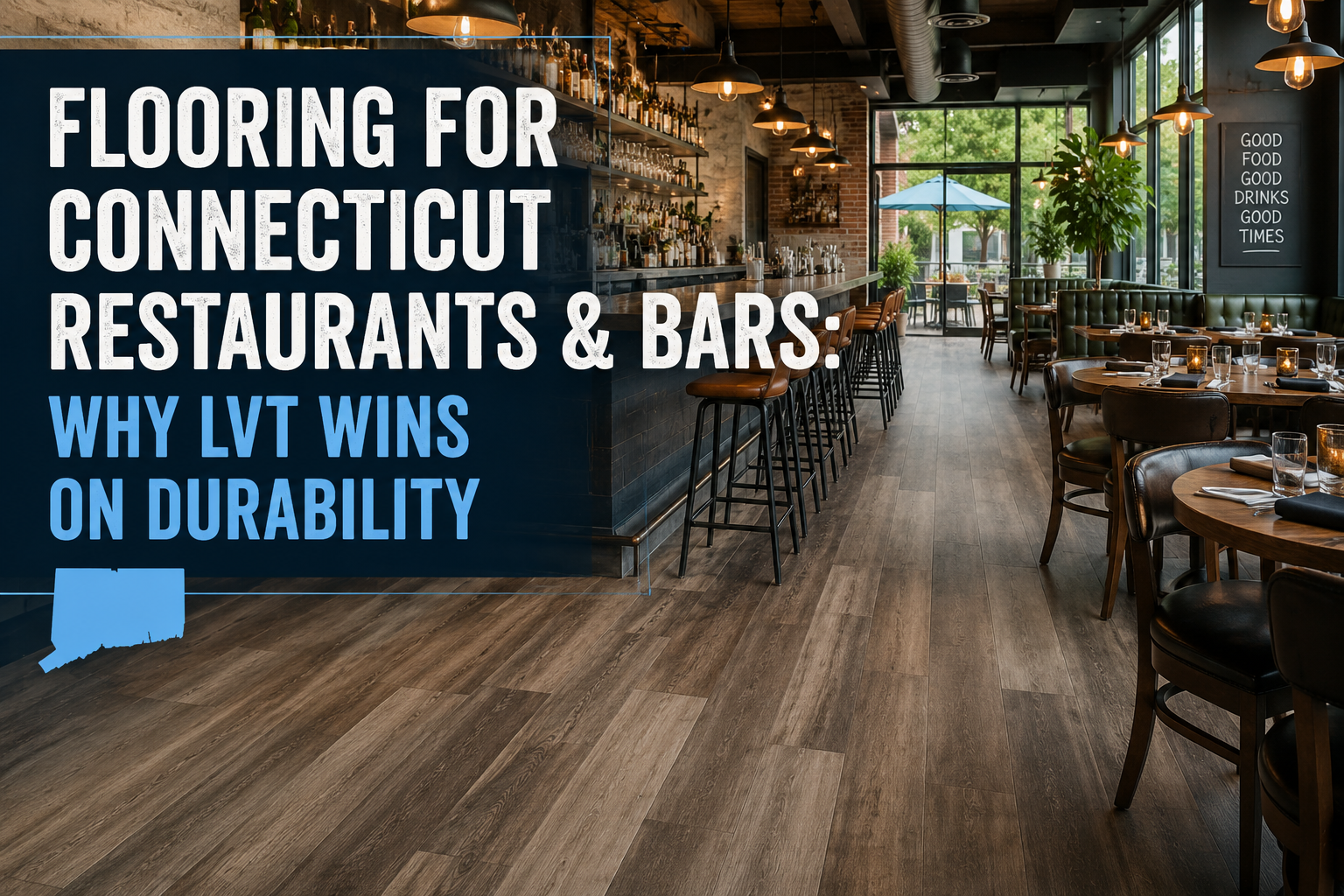
Flooring for Connecticut Restaurants & Bars: Why LVT Wins on Durability
It’s 7:45 on a Friday night at a Hartford County gastropub, and the dining room is at capacity. A server weaves past the bar carrying four pints, a bus tub clatters through the kitchen door, and a toddler two tables over has just dropped a fistful of French fries. None of that is unusual — it’s just Friday. But it’s also a preview of what a restaurant or bar floor absorbs every single service, week after week, for years. The material underneath all that activity matters far more than most owners realize, usually right around the time it starts to fail.
For Connecticut restaurant and bar owners planning a renovation or a new build-out, the flooring decision comes down to a real trade-off: the warmth of hardwood versus the punishing realities of a commercial kitchen and dining floor. Increasingly, the data — and the experience of flooring contractors working in Hartford County and Tolland County dining rooms — points toward luxury vinyl tile (LVT) as the more durable, lower-risk choice for high-traffic hospitality spaces.
The Real Cost of the Wrong Floor
Flooring failure in a restaurant isn’t just a cosmetic problem. It’s a safety and liability issue with a price tag attached. The National Floor Safety Institute estimates that more than three million foodservice employees and over one million restaurant guests are injured annually because of slips, trips, and falls in American restaurants1. The hospitality industry spends more than $2 billion each year on those injuries, and that figure has been climbing by roughly 10% annually2.
Most of those incidents trace back to the floor itself. Wet or contaminated surfaces are responsible for the majority of foodservice slip-and-fall accidents, with footwear, poor maintenance, and inadequate hazard identification accounting for most of the rest1. For an owner, that translates into a direct cost: the average general liability claim for a slip, trip, or fall in a restaurant runs around $3,550, before accounting for lost business, insurance premium increases, or reputational damage3. Surveys have found that a meaningful share of diners will avoid a restaurant altogether if they hear someone was hurt there3. In a competitive market like Hartford County, that’s not a risk worth carrying for the sake of a flooring material that looks good on day one but can’t hold up to real service.
Connecticut’s Restaurant Scene Is Growing — And So Is the Pressure on Floors
Connecticut’s hospitality sector isn’t standing still. In February 2026, the Connecticut Restaurant Association rebranded as the Connecticut Restaurant & Hospitality Association, reflecting an industry that now represents roughly 10,000 hospitality businesses and more than 170,000 employees statewide, generating close to $21 billion in annual economic impact and over $1.5 billion in state tax revenue4. That kind of growth means more restaurant and bar buildouts, more renovations, and more competition for the same customer base across towns like Glastonbury, Wethersfield, South Windsor, Vernon, Coventry, Cromwell, and Middletown.
It also means more pressure on the physical spaces themselves. Many commercial buildings in Hartford County and Tolland County occupy older structures — converted mill buildings, historic downtown storefronts, and mixed-use properties with basements or ground floors that see constant moisture from New England winters, de-icing salt tracked in at the door, and the humidity swings that come with a full New England year. A floor that can’t handle that combination isn’t just an aesthetic liability; it’s an operational one.
Why Traditional Hardwood Struggles Behind the Bar
Solid hardwood has real advantages in dining rooms — warmth, acoustics, and a look many restaurateurs want for their brand. But bars and high-traffic commercial dining floors expose hardwood to conditions it wasn’t built for: standing water near ice wells and dish pits, grease that seeps into seams, and the kind of funneled foot traffic at entrances, service doors, and restrooms that wears through a finish far faster than in a home. Refinishing can restore the surface, but it takes the space out of service, which is its own cost in a business that depends on turning tables every night of the week.
What Makes LVT the Better Bet for Restaurants and Bars
Luxury vinyl tile solves the problem hardwood can’t: it’s engineered specifically to be waterproof and abrasion-resistant while still delivering a convincing wood- or stone-look finish. The key spec to watch is wear layer thickness, measured in mils. Industry standards call for a minimum 20-mil wear layer for heavy commercial traffic, with many manufacturers recommending 28 to 40 mils with a urethane or aluminum-oxide finish for the busiest spaces — exactly the profile of a restaurant entrance, bar floor, or service corridor5,6. With proper installation and that kind of wear layer, commercial LVT typically holds up for 10 to 25 years depending on traffic and maintenance, a range that rivals or beats what most operators get out of a hardwood floor between refinishing cycles7.
Interior designers who specify flooring for hospitality projects have reached similar conclusions. As one commercial interior designer put it, LVT is “most practical when sand and water are variables”8 — a fair description of nearly every Connecticut bar floor between November and April. LVT also holds up to the pH-neutral cleaners and daily mopping that restaurant maintenance crews rely on, without the waxing, buffing, or periodic refinishing that hardwood requires to stay presentable.
Slip Resistance Matters as Much as Stain Resistance
Because more than 70% of restaurant falls happen on wet floors9, slip resistance is as important as durability when choosing a commercial floor covering. The National Floor Safety Institute’s ANSI B101.1 standard defines a “high traction” walking surface as one with a measured static coefficient of friction of at least 0.6 on a wet surface9. Quality commercial LVT products can be specified with textured, slip-resistant finishes that meet this threshold, giving bar and restaurant owners a floor that performs on both fronts: it resists the grease, spills, and moisture that cause problems, and it’s engineered to keep staff and guests on their feet when those spills inevitably happen.
What This Means for Restaurant & Bar Owners in Hartford and Tolland Counties
For a restaurant or bar owner weighing a renovation, the calculation isn’t simply “hardwood versus vinyl” in the abstract — it’s about which material matches the real conditions of a Connecticut commercial kitchen, bar, and dining room across a New England winter, spring mud season, and everything in between. LVT’s combination of waterproofing, wear-layer durability, and slip-resistant finish options makes it the more resilient choice for the areas that take the most abuse: bar floors, entrances, server stations, and dining rooms with heavy nightly turnover.
Mr Hardwood works with restaurant, bar, and commercial property owners throughout Hartford County, Tolland County, and the surrounding Connecticut towns to spec and install commercial-grade LVT flooring systems built for real-world service — not just a showroom sample. From initial walkthrough to final installation, the goal is a floor that still looks and performs the way it should years after opening night.
Ready to talk through flooring options for your restaurant or bar? Call Mr Hardwood at 203-GOT-WOOD or visit mrhardwood.com/contact to schedule a commercial consultation.
Frequently Asked Questions
Is LVT actually waterproof, or just water-resistant?
True LVT with a rigid SPC (stone plastic composite) or WPC (wood plastic composite) core is waterproof at the plank level, meaning standing water won’t damage the plank itself. Seams and edges still need to be installed correctly to keep moisture from reaching the subfloor, which is why professional installation matters as much as the product choice.
How long does commercial LVT actually last in a busy restaurant or bar?
Most commercial-grade LVT with an adequate wear layer lasts 10 to 25 years depending on traffic volume, maintenance, and installation quality7 — comparable to or longer than the interval most restaurants get between hardwood refinishing cycles.
Can LVT be installed over an existing hardwood or tile floor?
In many cases, yes, provided the subfloor is flat, stable, and properly prepped. A walkthrough is the best way to confirm what’s underneath and whether removal is necessary before installation.
Sources
[1] National Floor Safety Institute (NFSI) data, as cited in “An Introduction to Slip & Falls in America’s Restaurant Industry,” Restaurant Expert Witness. https://restaurantexpertwitness.com/blog/an-introduction-to-slip-falls-in-americas-restaurant-industry/
[2] National Floor Safety Institute (NFSI) data, as cited in “Restaurant Slip-and-Fall Accident Prevention Program,” AmTrust Financial. https://amtrustfinancial.com/getmedia/27eb9a10-fd2c-4d08-9511-d17b0bc425ee/RestaurantSlipFallAccidentPrevention-1.pdf
[3] “An Introduction to Slip & Falls in America’s Restaurant Industry,” Restaurant Expert Witness, citing Society Insurance (2021) and industry claims data. https://restaurantexpertwitness.com/blog/an-introduction-to-slip-falls-in-americas-restaurant-industry/
[4] “‘Not Separate Silos’: CRA Rebrands as Connecticut Restaurant and Hospitality Association,” CT News Junkie, February 18, 2026. https://ctnewsjunkie.com/2026/02/18/not-separate-silos-cra-rebrands-as-connecticut-restaurant-and-hospitality-association/
[5] “How To Choose The Right LVT Flooring for Commercial Use,” Mannington Commercial. https://blog.manningtoncommercial.com/how-to-choose-lvt-flooring-for-commercial-use
[6] “Heavy-Duty Commercial Vinyl Flooring: A Spec Guide,” Koffler Sales. https://kofflersales.com/blog/heavy-duty-commercial-vinyl-flooring/
[7] “How Long Does LVT Flooring Last in Commercial Spaces?,” Scherf Flooring Services. https://scherflooringservices.com/how-long-does-lvt-flooring-last-a-complete-guide-for-commercial-spaces/
[8] Jacki Arena, Jacki Arena Interiors, as quoted by Karndean Commercial. https://www.karndeancommercial.com/en-us/commercial-flooring/inspiration/sectors/hospitality–leisure/
[9] “How to Handle Slips, Trips, and Fall in a Restaurant or Bar,” Restaurant Expert Witness, citing NFSI/ANSI B101.1 standard. https://restaurantexpertwitness.com/blog/how-to-handle-slips-trips-and-fall-in-a-restaurant-or-bar/