
November 19, 2026
Hardwood floor gaps winter Connecticut
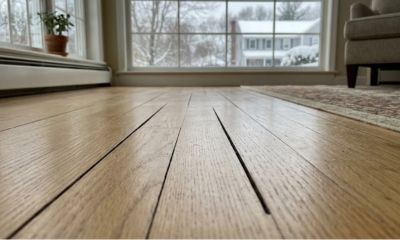
If you’ve noticed gaps appearing between your hardwood floorboards as the weather turns cold, you’re not alone. It’s one of the most common calls we get from Connecticut homeowners between November and March. Your floors looked fine all summer, and now you see visible spaces between the boards that weren’t there before.
The short answer is that this is normal wood behavior. The longer answer involves understanding why it happens, how to tell normal from abnormal, and what — if anything — you should do about it.
Why Wood Moves With the Seasons
Wood is a hygroscopic material, meaning it absorbs and releases moisture from the surrounding air. When humidity is high, wood absorbs moisture and expands. When humidity drops, wood releases moisture and shrinks.
In Connecticut, this cycle is pronounced. Summer humidity regularly pushes above 60–70% relative humidity. When winter heating starts—typically October through November—indoor humidity can drop to 20% or lower without intervention. That swing, 50 percentage points or more of relative humidity change, causes real dimensional change in wood flooring.
Hardwood boards shrink across their width as they dry out. In a floor with dozens of boards running side by side, that shrinkage adds up. A board that’s 3 inches wide might shrink 1/32 of an inch in width over the course of a dry winter. Multiply that across 20 boards in a 5-foot section, and you have visible gaps.
This is not a defect. It’s wood doing exactly what wood does.
Wide-plank floors show this more than narrow strip floors. A 5-inch or 7-inch plank has more total width to shrink than a 2¼-inch strip, so the gaps that develop are proportionally larger. If you have wide-plank floors and see gaps in winter, that’s expected behavior—not a sign of a poor installation.
What Normal Winter Gaps Look Like
Normal seasonal gaps have a few characteristics:
They’re consistent across the floor. If gaps appear roughly evenly distributed across the whole floor rather than concentrated in one spot, that’s seasonal movement behaving as expected.
They’re narrow. A gap you can see but couldn’t fit a coin into is well within normal range. Most seasonal gaps are 1/32 to 1/16 of an inch — noticeable if you’re looking for them, but not dramatic.
They close back up in spring and summer. This is the key indicator. If the gaps that opened in January have closed by May without any intervention, you experienced normal seasonal movement. The floor is working as it should.
They appeared gradually. Seasonal gaps develop over weeks as the heating season gets underway, not overnight.
The boards are still flat. Seasonal shrinkage causes gaps between boards, but the boards themselves should remain flat. If you’re seeing boards that are curling up at the edges or bowing in the center alongside the gaps, that’s a different issue.
What Abnormal Gaps Look Like
Not every gap is seasonal. Here’s when gaps signal something worth investigating:
Gaps that are wide enough to fit a nickel or quarter. Gaps this size suggest either extreme dryness, an installation issue, or a structural problem rather than normal seasonal movement.
Gaps concentrated in one area of the floor. If gaps cluster near an exterior wall, a heating vent, or along one side of a room, you likely have a localized moisture or temperature issue rather than general seasonal movement.
Gaps that don’t close in summer. If you’re heading into July and the gaps that opened in December are still there, something other than normal seasonal movement is at play. This could be a moisture problem in the subfloor, an installation error, or the floor having dried out beyond the range of normal recovery.
Gaps accompanied by other symptoms. Cupping (boards curling up at the edges), crowning (boards bowing upward in the center), squeaking that developed alongside the gaps, or boards that feel loose underfoot are signs of a moisture problem a professional should evaluate.
The Real Cause: Low Indoor Humidity
Normal seasonal gaps come from low indoor humidity, and the solution is to address the humidity—not patch the floor.
Connecticut homes in winter, especially those with forced-air heating systems, can drop to 15–25% relative humidity without any humidity control. The Hardwood Flooring Manufacturers Association recommends maintaining indoor relative humidity between 35% and 55% year-round to minimize wood movement. Most Connecticut homes, without intervention, fall well below that range in winter.
There are a few ways to address this:
Portable humidifiers placed in rooms with hardwood floors help, but they require consistent refilling and monitoring and rarely cover an entire home adequately. They’re a reasonable short-term measure but not a long-term solution for a whole house.
Whole-home humidifiers installed on a forced-air HVAC system are the most effective solution. They automatically maintain a set humidity level throughout the house without requiring daily attention. For Connecticut homeowners serious about protecting hardwood floors long-term, a whole-home humidifier is worth the investment.
Monitoring humidity with an inexpensive hygrometer (available for $15–30 at any hardware store) lets you know what you’re actually dealing with. Many homeowners assume their home is adequately humid without ever checking. A hygrometer in the main living area gives you real data.
What Not to Do
When gaps appear in winter, the instinct is often to fill them. Resist that instinct.
Don’t fill seasonal gaps with wood filler or caulk. Here’s why: when summer comes and humidity rises, the boards will expand back toward their summer dimensions. If you’ve filled the gaps with a rigid material, the expanding boards have nowhere to go. The result is buckling, crowning, or boards popping at the seams — damage that’s significantly more expensive to fix than gaps that would have closed on their own.
If the gaps genuinely bother you aesthetically, the right time to address them — if they warrant addressing at all — is after a full seasonal cycle has passed and you’ve confirmed they’re not closing on their own.
Don’t crank up the heat to compensate. Higher heat without added humidity makes the dryness worse, not better. Heat dries the air; humidity level matters for your floors, not temperature.
Don’t assume the installer did something wrong. The most common reaction when gaps appear is to blame the installation. In most cases, seasonal gaps are a humidity issue, not an installation issue. Before calling anyone to complain, let a full seasonal cycle pass and see whether the gaps close in spring.
When to Call a Professional
Most winter gaps don’t require professional attention. But call a flooring professional if:
- Gaps are wider than 1/8 inch across multiple boards
- Gaps are concentrated in one area rather than distributed evenly
- The gaps from last winter never fully closed over the summer
- You’re seeing cupping, crowning, or loose boards alongside the gaps
- The floor is making new squeaking sounds that developed with the gaps
A professional can assess whether you’re dealing with normal seasonal movement or a moisture problem that needs addressing before it causes permanent damage.
Planning for Next Winter
If you experienced significant gaps this year, act now—not next November, when the heating season is already underway.
Getting a whole-home humidifier installed before heating season starts is the single most effective thing a Connecticut homeowner can do to protect hardwood floors. Combined with regular monitoring of indoor humidity levels, it keeps floors in the 35–55% humidity range where wood is stable and seasonal movement stays minimal.
If your floors have developed permanent gaps — ones that didn’t close over the summer — refinishing may be an option depending on the severity. In some cases, you can re-glue boards or replace them individually. A professional assessment will tell you what’s realistic.
Frequently Asked Questions
Are winter gaps in hardwood floors normal?
Yes, in most cases. Wood expands and contracts with changes in humidity, and Connecticut winters — with low outdoor temperatures and dry indoor heating air — consistently drop indoor humidity below the range where wood is stable. Small, evenly distributed gaps that open in winter and close in spring are normal seasonal behavior, not a defect.
How big is too big a gap?
Gaps narrow enough that you can’t fit a coin into them are generally within normal seasonal range. If you can slide a nickel into a gap, that’s on the larger end and worth monitoring. If gaps are wide enough to fit a quarter, that warrants a professional look — especially if they don’t close in summer.
Should I fill the gaps in my hardwood floors?
Not during winter. If you fill gaps with wood filler or caulk while the boards are at their driest and smallest, they’ll expand in spring and summer and have nowhere to go. The result is often buckling or popping seams. Only consider filling gaps that have remained open through a full summer — meaning they’re permanent, not seasonal.
Why are the gaps worse in some rooms than others?
Gaps tend to be worse near heating vents, exterior walls, and windows — areas where the air is driest or where temperature fluctuates most. South-facing rooms that get a lot of winter sun can also dry out faster than north-facing rooms. If gaps are concentrated in one area, look for a localized source of dryness.
Will a humidifier really help my floors?
Yes — it’s the most direct solution. A whole-home humidifier that maintains 35–55% relative humidity year-round will significantly reduce seasonal wood movement. Portable humidifiers help in individual rooms but are hard to maintain consistently across a whole house. If you have hardwood floors throughout your home and you’re not controlling humidity, you’re leaving your floors at the mercy of the weather.
My floors have always had gaps in winter. Is something wrong with them?
Not necessarily. If the pattern has been consistent — gaps appear in December and close by April — that’s normal seasonal behavior. The question is whether you want to minimize it going forward (humidity control is the answer) or whether the gaps have been getting progressively larger or not closing fully (which warrants a professional assessment).
Mr. Hardwood works with homeowners throughout Hartford County on hardwood floor assessment, refinishing, and repair. If you’re unsure whether the gaps in your floors are seasonal or need attention, we’re happy to take a look and give you an honest assessment.
Sources:
- Wood Flooring and Humidity — National Wood Flooring Association
- Hardwood Floor Gaps: Causes and Solutions — This Old House
- Why Hardwood Floors Gap in Winter — Bob Vila
- Indoor Humidity and Wood Floors — Wood Floor Business
- Whole-Home Humidifiers Guide — Family Handyman
- Hardwood Flooring Moisture Guidelines — NWFA