
October 17, 2026
Tile Flooring Connecticut: When It’s the Right Call
Tile flooring in Connecticut is one of those decisions that looks simple on the surface but gets complicated quickly once you dig into the details. The material itself — ceramic or porcelain — is proven, durable, and one of the few flooring options that genuinely improves with age rather than deteriorating. In the right room with proper installation, a tile floor can last 50 years or more without refinishing, replacement, or significant maintenance. But tile also has real demands: subfloor preparation that older Connecticut homes don’t always accommodate easily, a cold-underfoot feel that Connecticut winters make very noticeable, and a grout-maintenance reality that surprises homeowners who expected a completely maintenance-free floor.
This guide covers what Connecticut homeowners need to know about tile flooring — the difference between ceramic and porcelain, where tile performs best in Hartford County homes, what installation actually requires, and how to get the result right the first time.
Ceramic vs. Porcelain: The Difference That Matters Most in Connecticut
The first decision in any tile project is the choice between ceramic and porcelain — and in Connecticut’s climate, that decision has a clear answer for most applications.
Both ceramic and porcelain are clay-based tiles fired in a kiln, but porcelain uses a finer, denser clay and is fired at significantly higher temperatures. The result is a tile that is harder, denser, and far less porous than ceramic. Porcelain has a water absorption rate below 0.5% — making it virtually impervious to moisture. Ceramic tile, while moisture-resistant, is more porous and absorbs water at a higher rate, making it less suitable for wet environments and more vulnerable to freeze-thaw cycles.
For Connecticut’s climate, porcelain is the more practical choice in the spaces where tile is most commonly installed—bathrooms, mudrooms, kitchens, and entryways. These rooms see the most moisture, the most tracked-in Connecticut winter debris, and, in the case of entryways, the potential for freeze-thaw conditions near exterior doors. Porcelain handles all of these demands without deteriorating. Ceramic performs acceptably in low-traffic, lower-moisture applications — a bedroom floor, a powder room that sees limited use — but for the high-demand rooms in a Hartford County home, porcelain is the stronger specification.
The cost difference reflects the performance gap. Ceramic tile runs about $12 to $25 per square foot installed; porcelain runs $15 to $50 per square foot installed, depending on tile size, pattern complexity, and required subfloor preparation. For most Connecticut homeowners, the added cost of porcelain in bathrooms, mudrooms, and kitchens is justified by its durability — a porcelain floor installed correctly in 2026 can still perform well in 2076.
Where Tile Performs Best in Connecticut Homes
Tile’s strengths—water resistance, durability, and ease of cleaning—make it the right choice for specific rooms in every Connecticut home.
Bathrooms are the clearest application. Porcelain tile in a bathroom handles direct water exposure, cleaning chemicals, and daily use without deterioration. It doesn’t harbor bacteria or mold on the tile surface, and with the right grout and proper sealing it’s the most hygienic hard-surface flooring option available. The cold-underfoot concern—tile’s main comfort drawback—is most commonly addressed in bathrooms by pairing tile with electric radiant floor heating, which adds $6 to $12 per square foot to the project but transforms the bathroom experience in Connecticut winters.
Mudrooms and entryways are where tile genuinely earns its place in Connecticut homes. From November through April, these spaces absorb snow, road salt, sand, and tracked-in grit on every pass through the door. Porcelain handles it all without swelling, staining, or surface deterioration. It can be mopped aggressively, tolerates de-icing salt residue, and doesn’t require the care that hardwood or even LVP demands in these high-abuse spaces. A well-installed porcelain mudroom floor in a Hartford County colonial is genuinely low-maintenance for decades.
Kitchens are a strong application for tile, particularly around high-moisture zones. Porcelain tile handles kitchen spills, steam from cooking, and the constant cleaning demands of a working kitchen without issue. The main consideration in Connecticut kitchens is comfort underfoot — tile’s hard, cool surface is less forgiving for people who spend long periods standing while cooking. Anti-fatigue mats at prep and cooking stations address this in a practical way.
Laundry rooms are a natural fit for tile. The moisture exposure from washing machines, utility sinks, and steam from dryers makes tile the most durable and appropriate choice for these utility spaces.
Where Tile Is Not the Right Call
Tile has real limitations that make it the wrong choice in certain Connecticut applications, and being honest about them prevents expensive regret.
Main living floors — living rooms, dining rooms, bedrooms — are rarely the right place for tile in Connecticut homes. The cold-underfoot feel is more noticeable in these spaces, where family members spend significant time on the floor, and tile’s acoustic properties (hard, reflective, echoing) work against the warmth and comfort most homeowners want in their living spaces. Hardwood, engineered hardwood, or LVP are almost always the better choice for Connecticut main living floors.
Rooms with subfloor movement need special attention. Tile is rigid — it doesn’t flex. When installed over a subfloor that has any spring, flex, or movement, tile and grout will crack over time as the subfloor moves beneath the rigid tile surface. This is a significant consideration in older Hartford County homes, where floor joists may have deflected over decades and subfloors that feel solid underfoot may still flex enough to crack tile over time. A professional assessment of subfloor deflection before tile installation is essential in any Connecticut home built before 1970.
Subfloor Preparation: The Most Important Step in Connecticut Tile Projects
The single most common reason tile floors fail prematurely in Connecticut homes is inadequate subfloor preparation. Tile installation is only as good as what’s underneath it, and in older Hartford County homes, what’s underneath often requires significant work before you can install tile correctly.
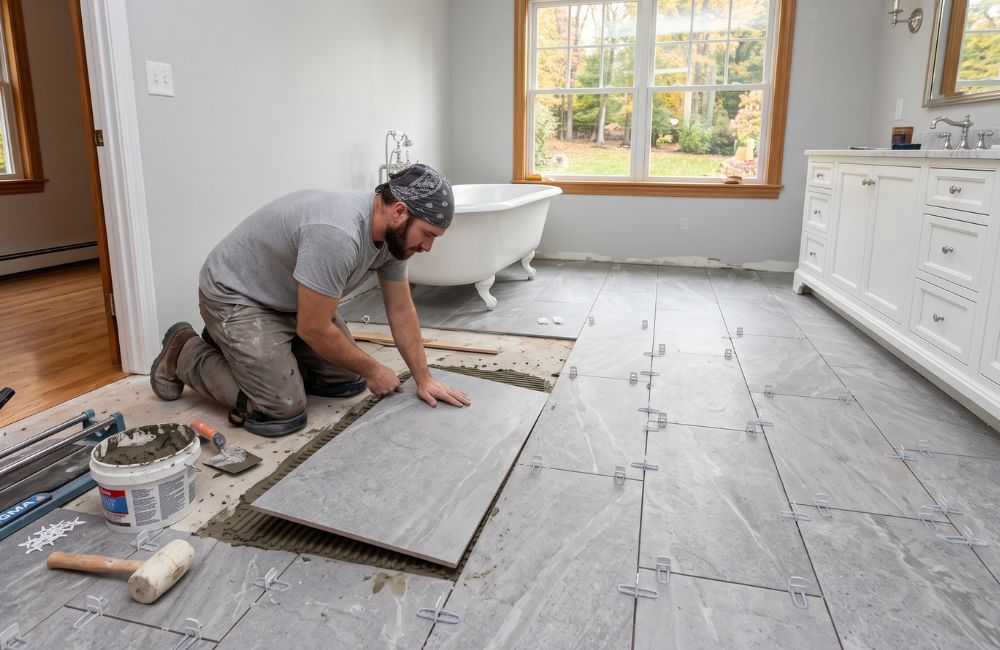
Industry standards require subfloors to be flat within 1/8 inch over 10 feet for tile installation. Older Connecticut homes often don’t meet that standard without leveling work—self-leveling compound that fills low spots and creates the flat, rigid surface tile requires. Subfloor leveling typically adds $2 to $5 per square foot to a tile project. Still, it’s not optional: tile installed over an uneven subfloor develops hollow spots, cracks at the grout lines, and eventually loosens from the adhesive.
In bathrooms and wet areas, a waterproofing membrane between the subfloor and the tile layer is standard practice — and critical in Connecticut homes where moisture from above and below can accumulate in bathroom subfloors over time. Skipping the waterproofing membrane to save cost is one of the most consequential shortcuts in tile installation, producing subfloor water damage that costs far more to repair than the membrane would have cost to install.
For older Connecticut homes with wood subfloors, cement backer board installed over the subfloor before tile provides the rigid, stable, moisture-resistant surface that tile adhesive requires. This adds height to the floor — a factor that affects transitions to adjacent flooring, door clearances, and appliance fits in kitchens — and should be planned for before installation begins. For more on how tile fits into a broader flooring plan for Connecticut homes, see Mr. Hardwood’s Connecticut flooring guide.
Grout: The Maintenance Reality
Grout is the most maintenance-intensive component of a tile floor, and Connecticut homeowners should understand what it requires before committing to tile in high-traffic spaces.
Standard cement-based grout is porous and absorbs stains, moisture, and bacteria over time without regular sealing. In a Connecticut mudroom or kitchen—spaces that see heavy traffic and regular moisture—unsealed or poorly maintained grout darkens, stains, and can develop mildew. Sealing grout at installation and resealing annually in high-traffic areas is the baseline maintenance requirement for keeping tile floors looking clean.
Epoxy grout is an alternative worth discussing with your installer for high-traffic or high-moisture applications. Epoxy grout is non-porous, stain-resistant, and doesn’t require sealing — it’s more expensive and harder to install than cement grout. Still, it eliminates most ongoing maintenance concerns in demanding spaces like mudrooms and kitchens.
Radiant Heat and Tile in Connecticut Bathrooms
The most common upgrade paired with tile installation in Connecticut bathrooms is electric in-floor radiant heating. Tile’s thermal conductivity — the same property that makes it cold underfoot in winter — makes it the best flooring material for radiant heat. The tile absorbs heat from the cables or mats beneath it. It releases it evenly across the floor surface, creating a warm bathroom floor that completely transforms the Connecticut winter bathroom experience.
Electric radiant systems installed under bathroom tile typically run $6 to $12 per square foot including materials and electrician labor for a standard bathroom. Operating costs are minimal — most bathroom systems run $14 to $20 per month during the heating season. For Connecticut homeowners doing a bathroom tile project, pricing in-floor heating at the time of tile installation is significantly less expensive than adding it later. For guidance on flooring choices for a room with radiant heat, ask Mr. Hardwood about your project.
The Bottom Line
Tile flooring in Connecticut is one of the most durable and long-lasting investments a homeowner can make — in the right rooms, with the right preparation, and with the right material specification. Porcelain over ceramic in wet and high-traffic spaces, thorough subfloor preparation in older Hartford County homes, and electric radiant heat in bathrooms are the three decisions that most determine whether a Connecticut tile project performs beautifully for decades or becomes an expensive maintenance problem within a few years.
Frequently Asked Questions
Is porcelain or ceramic tile better for Connecticut homes?
Porcelain is the stronger choice for most Connecticut applications. Its lower water absorption rate — below 0.5% compared to ceramic’s higher porosity — makes it better suited to the moisture-heavy spaces where tile is most commonly installed in CT homes: bathrooms, mudrooms, kitchens, and entryways. Porcelain also handles Connecticut’s freeze-thaw conditions near exterior doors better than ceramic. Ceramic is acceptable in low-traffic, low-moisture applications like bedroom floors or decorative wall applications. Still, for the demanding rooms in a Hartford County home, porcelain is the appropriate specification.
How much does tile flooring cost in Connecticut?
Tile installation in Connecticut typically runs $12 to $25 per square foot for ceramic and $15 to $50 per square foot for porcelain, fully installed. Those ranges include materials, adhesive, grout, and labor but not subfloor preparation — which in older Hartford County homes can add $2 to $5 per square foot for leveling and $1 to $3 per square foot for backer board. A 100-square-foot bathroom tile project in Hartford County commonly runs $2,000 to $5,000 total once you factor in subfloor prep, materials, and installation.
Can tile be installed over an existing floor in a Connecticut home?
In some cases, yes — but with important caveats. You can install tile over existing tile if the existing floor is flat, firmly adhered, and structurally sound. Tile over hardwood is generally not recommended because wood’s natural movement causes tile to crack over time. Tile over vinyl or laminate requires removing the existing floor first. In every case, the critical question is subfloor flatness and rigidity — any existing floor installed over an uneven or springy subfloor will create the same problems for new tile as a direct subfloor installation would.
How do I keep grout clean in a Connecticut mudroom?
The most effective approach is prevention and regular sealing. Apply a penetrating grout sealer at installation and reseal annually in high-traffic areas like mudrooms. Day to day, a pH-neutral tile cleaner and a stiff grout brush handle routine cleaning effectively. For Connecticut mudrooms specifically—where road salt, sand, and winter grit accumulate—a weekly damp mop during the November-to-April season prevents salt residue from etching into unsealed grout over time. If existing grout is already stained, a professional grout cleaning and re-sealing service can restore it significantly before staining becomes structural.
Is tile flooring a good investment for Connecticut home resale?
Yes, in the right rooms. Tile in bathrooms, kitchens, mudrooms, and entryways is a standard, expected finish for Connecticut buyers and appraisers—it adds value and reduces buyer concern about maintenance. Tile throughout a home’s main living spaces is less universally desirable to Connecticut buyers, who typically prefer hardwood or a wood-look alternative in living rooms and bedrooms. The highest-return tile investment in a Hartford County home is a well-executed bathroom tile project, which consistently ranks among the top ROI renovation projects for Connecticut sellers.
Sources
This Old House — “Ceramic vs. Porcelain Tile: Which Is Better?” (2026)
Daltile — “Ceramic vs. Porcelain Tile: What’s the Difference?”
UseCalcPro — “How Much Does Tile Flooring Cost in 2026?”
RUBI — “2026 Tile Floor Installation Cost Guide”
WarmlyYours — “Radiant Floor Heating Cost in 2026”
HGTV — “Ceramic vs. Porcelain Tile: What’s the Difference?” (2025)
—
Planning a tile flooring project in Hartford County? Mr. Hardwood installs ceramic and porcelain tile throughout Connecticut and offers free estimates. Call 203-GOT-WOOD or visit mrhardwood.com.