
August 27, 2026
What Dental Practices Across Hartford County Need From Commercial LVT Flooring
A dental operatory is one of the few commercial spaces where the floor has to perform like a clinical surface and look like a spa. It takes daily contact with blood, saliva, disinfectant chemicals, and handpiece water spray, gets rolled over by delivery carts and mobile imaging units, and still has to read as calm and clean to a patient who may already be anxious about the visit. Whether it’s a solo general practice off Route 3 in Cromwell or a multi-chair group practice going into a new suite in Rocky Hill, the flooring decision is as much an infection-control call as a design one — and it’s one of the areas where dental offices differ most from a standard medical or corporate build-out.
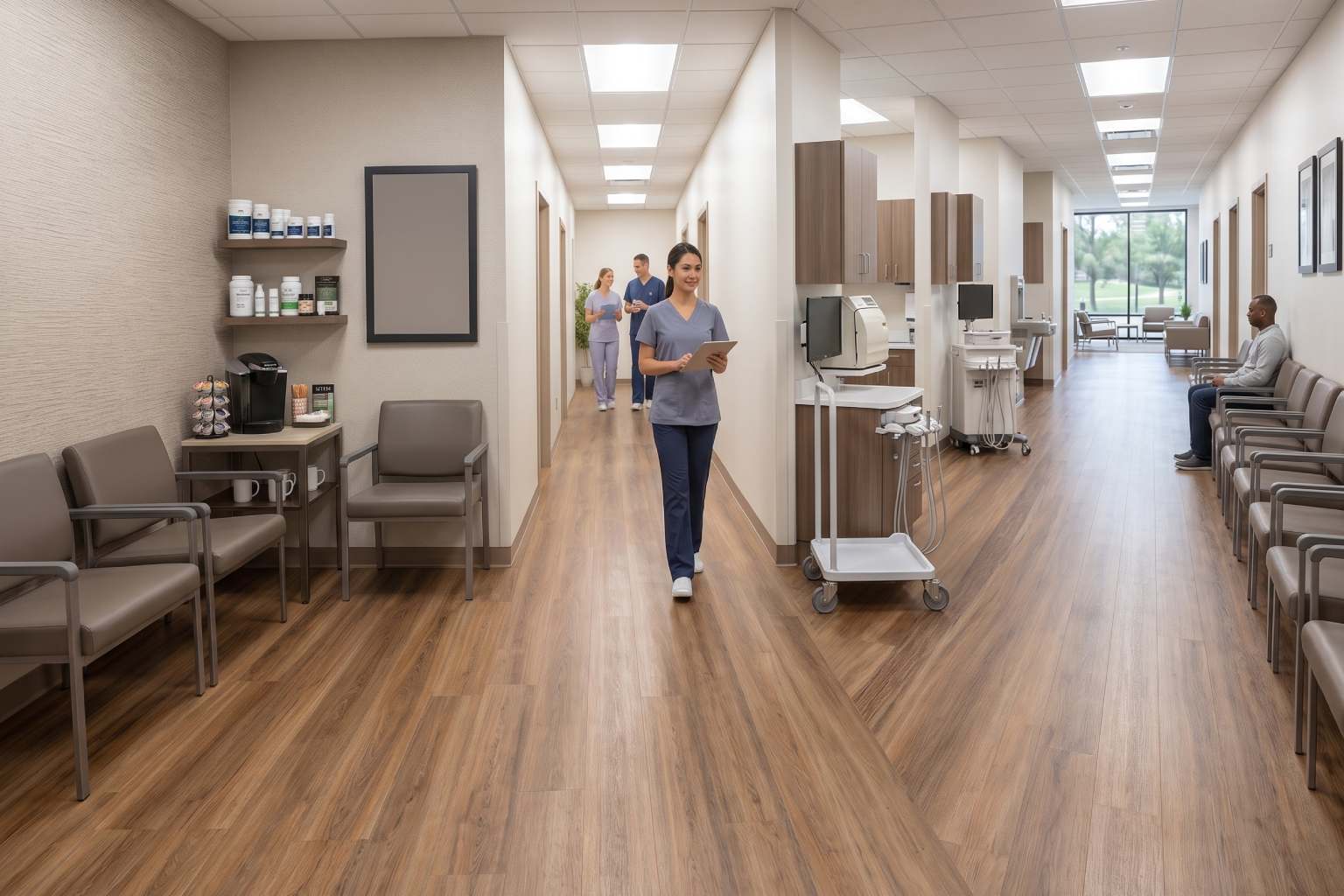
Commercial-grade luxury vinyl tile (LVT) has become the default answer for Hartford and Tolland County dental practices for exactly that reason: it can be installed as a seamless, easily disinfected surface in the operatories and sterilization room, then transition to a warmer, branded look in reception without changing materials.
Why Infection Control Drives the Flooring Choice
CDC’s guidelines for infection control in dental health-care settings call for clinical-area surfaces that are smooth, nonporous, and easily cleaned and disinfected between patients, and specifically caution against carpeting and upholstered furniture in areas where spatter or spray from dental procedures is likely.¹ Environmental surfaces still have to be cleaned before they’re disinfected, and that two-step process only works if the floor itself doesn’t have seams, grout lines, or a porous surface where bioburden can collect.² It’s a good reminder of how much surface hygiene matters across every care setting: on any given day, CDC surveillance finds about 1 in 31 hospital patients has at least one healthcare-associated infection, and while that figure comes from acute-care hospitals rather than dental offices specifically, it’s the same underlying principle driving how clinical surfaces get specified everywhere patients receive care.³
That’s the case against carpet in an operatory, and it’s also the case against standard ceramic tile, whose grout lines are just as hard to keep sealed and disinfected over years of daily use. Commercial LVT, installed with heat-welded seams and an integral flash-cove base where the flooring turns up the wall in one continuous piece, gives a practice a monolithic surface with nowhere for spills or debris to hide — which is exactly what CDC’s environmental infection control recommendations are asking for.
What a Dental Office Actually Puts a Floor Through
Beyond the clinical demands, a dental office floor absorbs more physical wear than most people realize. Sterilization carts, mobile X-ray and CBCT units, supply carts, and rolling stools move along the same paths dozens of times a day, and reception floors have to accommodate patients arriving in wheelchairs, walkers, and strollers. Add regular exposure to disinfectant chemicals — many of which are harsher than a standard office cleaner — and it’s easy to see why residential-grade flooring doesn’t last in a working practice.
On the Mr. Hardwood side, we spec dental jobs around the same commercial standards we’d use in a hospital outpatient suite:
- Wear layer thickness — 20 mil or heavier in operatories, sterilization rooms, and hallways; 12–20 mil is often sufficient in private offices and consult rooms.
- Slip resistance — NFSI and ANSI B101.1 wet/dry coefficient-of-friction thresholds, particularly around sinks, sterilization areas, and chairside zones where water and disinfectant get splashed.
- Heat-welded seams and integral cove base — a fully monolithic surface in clinical areas, matching CDC’s recommendation for surfaces free of joints that trap contamination.
- Low-VOC, FloorScore-certified product — off-gasses quickly enough that a practice can reopen the next business day instead of losing a full week of patient chairs.
Sterile Operatory, Welcoming Reception — Same Material, Different Job
The advantage of a rigid-core LVT platform is that a practice doesn’t have to choose between clinical performance and a warm, rather than institutional, reception area. We regularly run a sheet-vinyl or heat-welded LVT system through the operatories and sterilization room, then shift to a wood-look rigid-core LVT plank in reception, hallways, and consult rooms — same underlying material family, same maintenance routine for staff, but a very different visual experience for the patient walking in the front door versus the one being walked back to a chair.
A Tight-Knit Local Market
Connecticut’s dental community is smaller and more connected than people outside it might expect. Roughly 65% of practicing dentists in the state were trained at UConn’s School of Dental Medicine in Farmington, which means referrals — for associates, equipment, and contractors alike — travel fast through the same professional network.⁴ That’s part of why Mr. Hardwood has been picking up more dental build-out and renovation work across Glastonbury, Wethersfield, South Windsor, Vernon, and the Rocky Hill/Cromwell corridor: once one practice in a network is happy with the result, the next referral usually isn’t far behind.
It also tracks with what’s happening in the flooring category more broadly. The global luxury vinyl tile market was valued at roughly $29 billion in 2024 and is projected to grow to $46.3 billion by 2030, with healthcare and other institutional segments identified as among the fastest-growing applications.⁵ Dental practices — small footprints, high standards for hygiene, frequent renovation cycles as practices expand or bring on associates — are a natural fit for that growth.
“A dental office can’t afford to shut down for a week to redo the floors, and it can’t afford a floor that looks tired in a waiting room where patients are sitting with nothing to do but look around. We build the schedule around their hours, use products that pass off quickly, and give them an operatory floor that holds up to disinfectant every single day without breaking down.”
— Rob Girard, Owner, Mr. Hardwood
Frequently Asked Questions
Can you install without closing the practice for more than a day?
Most single-operatory or small-suite jobs are scheduled over a weekend or a run of evenings, so a practice reopens on its next normal business day. Low-VOC, FloorScore-certified products are a big part of making that timeline work — they cure and off-gas fast enough that staff and patients can be back in the space almost immediately.
What’s the best flooring for the sterilization room specifically?
Heat-welded sheet vinyl or LVT with an integral flash-cove base, so the floor turns up the wall in one seamless piece with no gap where the floor meets the base molding. That eliminates the seams and corners where debris and moisture tend to collect in a room that’s cleaned constantly.
Does LVT actually meet infection-control expectations for clinical space?
Yes, when it’s specified and installed correctly. CDC’s guidance calls for smooth, nonporous surfaces that can be cleaned and disinfected between patients — commercial LVT with heat-welded seams meets that standard in ways that carpet and grouted tile don’t.¹
Can reception flooring match our practice’s brand colors?
Yes — rigid-core LVT comes in a wide range of wood, stone, and abstract looks, and we regularly help practices pick a plank or tile pattern that complements their logo and signage rather than fighting it.
What does commercial LVT typically cost for a dental office?
Pricing depends on square footage, whether it’s a sheet-vinyl clinical system or rigid-core plank, and subfloor prep. We provide a walkthrough and written estimate before any work begins so a practice can budget accurately.
Get a Dental Office Flooring Estimate
Mr. Hardwood is based in Rocky Hill and installs commercial flooring for dental practices throughout Hartford County and Tolland County — from single-doctor offices to multi-location group practices in Glastonbury, Wethersfield, South Windsor, Vernon, Coventry, and Middletown. We schedule around your hours and spec every operatory and reception space to support daily clinical use.
Sources
- Centers for Disease Control and Prevention, “Guidelines for Infection Control in Dental Health-Care Settings — 2003,” MMWR 52(RR-17). https://cdc.gov/mmwr/preview/mmwrhtml/rr5217a1.htm
- Centers for Disease Control and Prevention, “Cleaning and Disinfecting Environmental Surfaces” (Dental Infection Prevention and Control FAQs). https://www.cdc.gov/dental-infection-control/hcp/dental-ipc-faqs/cleaning-disinfecting-environmental-surface.html
- Centers for Disease Control and Prevention, “HAIs: Reports and Data.” https://www.cdc.gov/healthcare-associated-infections/php/data
- UConn Health, “Supplying CT’s Health Care Workforce,” The Pulse, April 2022. https://health.uconn.edu/?p=6736
- ResearchAndMarkets via Business Wire, “Luxury Vinyl Tile Floor Coverings Business Report 2025-2030,” Oct. 2025. https://www.businesswire.com/news/home/20251007290294/en